Latest posts from Codename One.
Blog
Insights, release updates, tutorials, and engineering notes from the Codename One team.
Don't Order Fish on Monday. Don't Release on Friday
Anthony Bourdain’s famous warning about Monday fish was a warning about the supply chain behind the menu. In his 1999 essay, he described seafood bought for the weekend still being served on Monday. Knowing how the kitchen worked changed what he would order. Developers have a similar rule: never release on Friday. If something breaks, you have just made plans for everyone’s weekend. It is excellent advice that we have ignored for years. ...
Do You Want Your Web App to Feel Like a Native App?
You can give your Codename One web app the same desktop theme family as your users’ operating system: Aqua on macOS, Fluent on Windows, or Adwaita on Linux. Menus can sit above the app in HTML, with commands such as File and View visible instead of tucked into a mobile overflow menu. That gives you a browser version of your app that fits more comfortably on a desktop. The JavaScript port now supports both choices, and the same theme work reaches the Certificate Wizard you use to sign your apps. ...
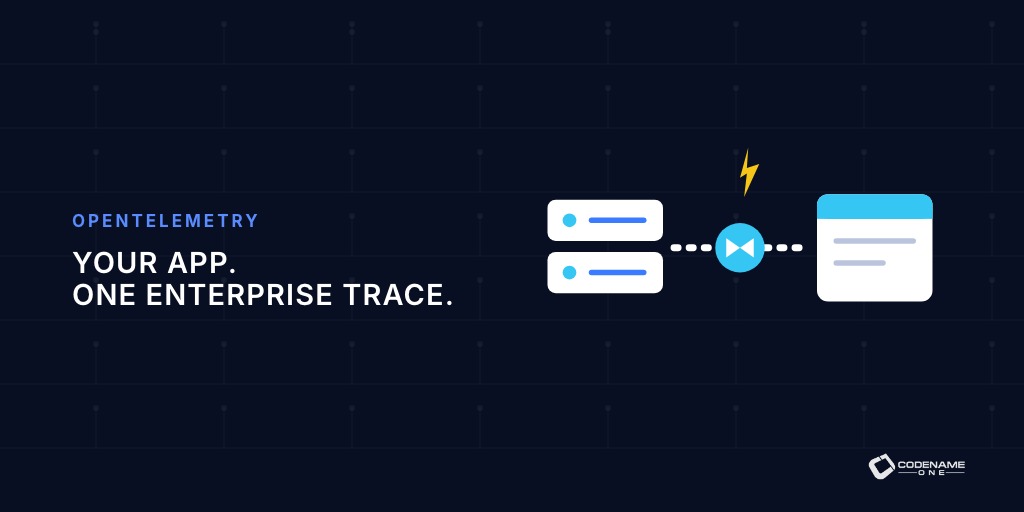
Connect Your App to Your Enterprise Traces
Your customer taps “Place order.” The request crosses your app, an API gateway, a native backend, a payment service and a database. Your operations team needs to see that path in the same tracing system it uses for the rest of the company. Neither the client app nor a compiled Java server should disappear from that picture. I wrote a book on debugging, so I am probably more opinionated about this than most people: in 2026, production diagnosis should not depend on somebody searching a pile of logs with grep and guessing which lines belong together. ...
Do You Prefer Gradle?
You can now choose Gradle for a Codename One project. Start with fewer files, add platform directories when you need native code, or create a standalone backend without a mobile app attached. A smaller project is easier to browse and leaves less scaffolding competing for space in an LLM’s context. I like Maven XML. I know it is verbose. I also spent enough time at Sun Microsystems staring at deeply scripted, heavily patched make files to develop a lasting suspicion of clever build systems. ...
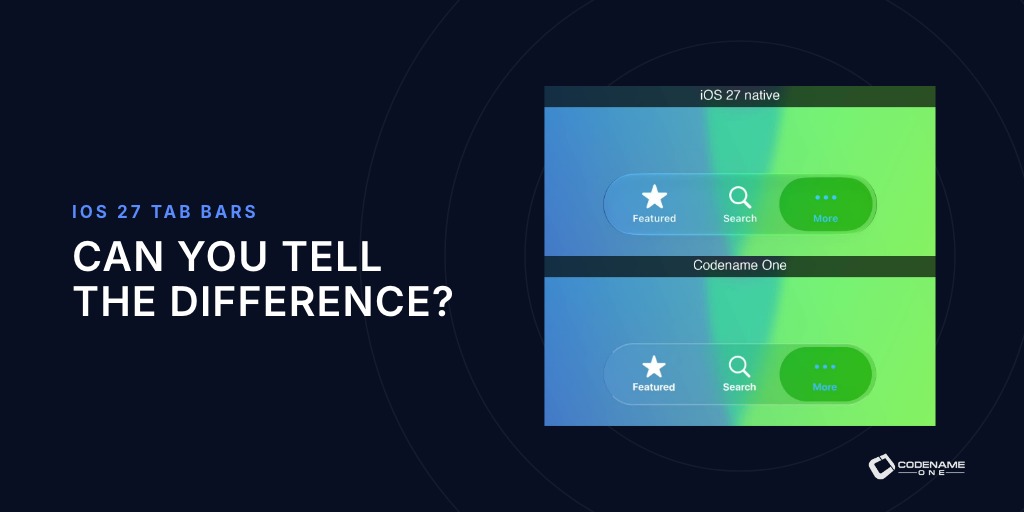
Can You Tell the Difference Between These iOS Tab Bars?
Watch how the two tab bars respond to the recorded taps, holds, drags and changes of direction. Can you tell which one is UIKit and which one is drawn by Codename One? That is a more useful test than a still image. Your users feel the delay before a selection moves, the way the glass follows a finger and the settling motion after release. A tab bar can have the right colors and still feel wrong in your hand. ...
Honey, I Shrunk Java
The current Linux ARM64 performance baseline has ParparVM translating its own compiler in 37.5% less elapsed time and 45.8% less peak memory than JDK 25. Across all 16 recorded machine configurations, self-translation takes 22.5% to 56.6% less elapsed time. The gains vary by OS and processor; the chart and table include every configuration. Your Java source does not need to change to benefit from a smaller runtime and a compiler that removes more work. ...
A Smaller, Faster Java Server with a Spring-Style API
What do you pay for Spring and Java’s dynamic architecture? Can you deliver the same API without the same runtime cost? For a small service, you might want dependency injection, transactions and scheduled jobs without a long startup or a large deployment. That is the case our native Java backend is trying to make. Write a controller and a service, compile their wiring into the application, then deploy a native executable. ...
Native Desktop Themes for Production Apps
A desktop app needs more than larger versions of its phone controls. Dialogs need their own windows. Title bars, scrollbars, and keyboard focus need to behave as desktop users expect. Last week we introduced the native desktop theme experiment. This week we bring those themes into production use. Fluent, Aqua, and Adwaita include refined controls in light and dark appearances, plus the window and dialog defaults that go with them. Your application can inherit those styles and retain its own branding. ...
Your Push Request Succeeded. The Device Key Is Dead.
Your server sends a push request and gets a successful response. Somewhere in the target list is a device key that stopped working weeks ago. The response can’t identify it because the provider hasn’t answered yet. BuildCloud now sends delivery feedback to your backend. It closes the gap between admitting the request and learning what happened during provider delivery, so your own device database can stop retaining keys that the provider has rejected. ...
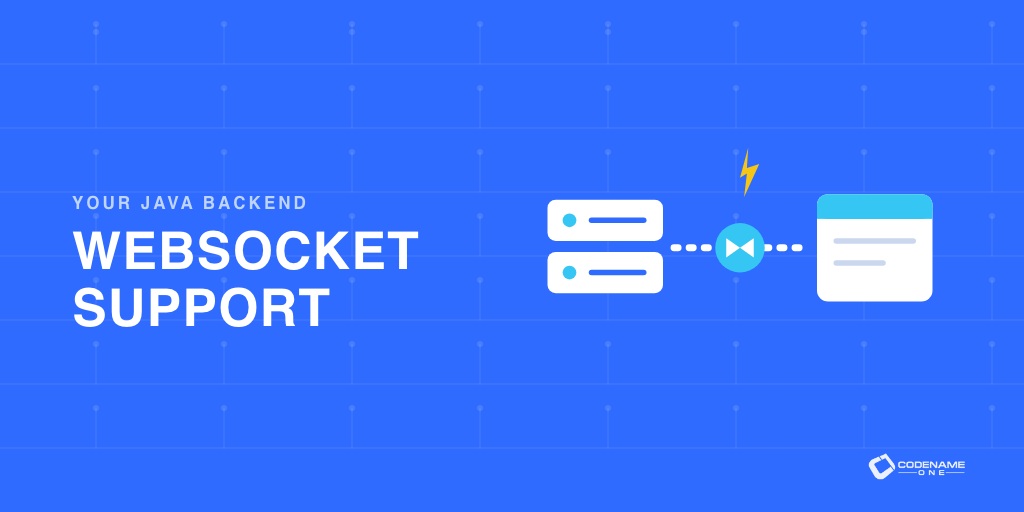
WebSocket Support for Your Java Backend
A job finishes on the server. The app should know about it without asking the same HTTP endpoint every few seconds. WebSockets keep a two-way connection open so either side can send a message when there’s something to report. The Codename One backend now supports RFC 6455 WebSockets, with Java callbacks for text and binary messages. The client API, com.codename1.io.WebSocket, already existed. This release adds the server half, com.codename1.backend.WebSocket, and @WebSocketMapping to register an endpoint. ...
OpenTelemetry Support from App to Database
A user taps Save. The spinner stays up for three seconds. Your API dashboard says the server is healthy, and the database log contains thousands of queries. Which of those facts explains the wait? Distributed tracing gives the operation a shared identity as it crosses process boundaries. Codename One now instruments app requests and backend work so you can follow that path into a tracing system your team already uses. The entry point is an annotation on each side. ...
JPA Inspired ORM from SQLite to PostgreSQL
Changing a customer’s name should not require remembering which DAO to call after every assignment. Loading twenty orders should not accidentally fetch each customer’s entire history. Those are the kinds of problems that appear once an application grows beyond a few independent tables. Last week’s ORM example introduced shared entities and generated DAOs. This release adds a managed session: an object that keeps track of the entities involved in one unit of work, detects their changes, and coordinates persistence. Relationships now belong in the model too. ...